
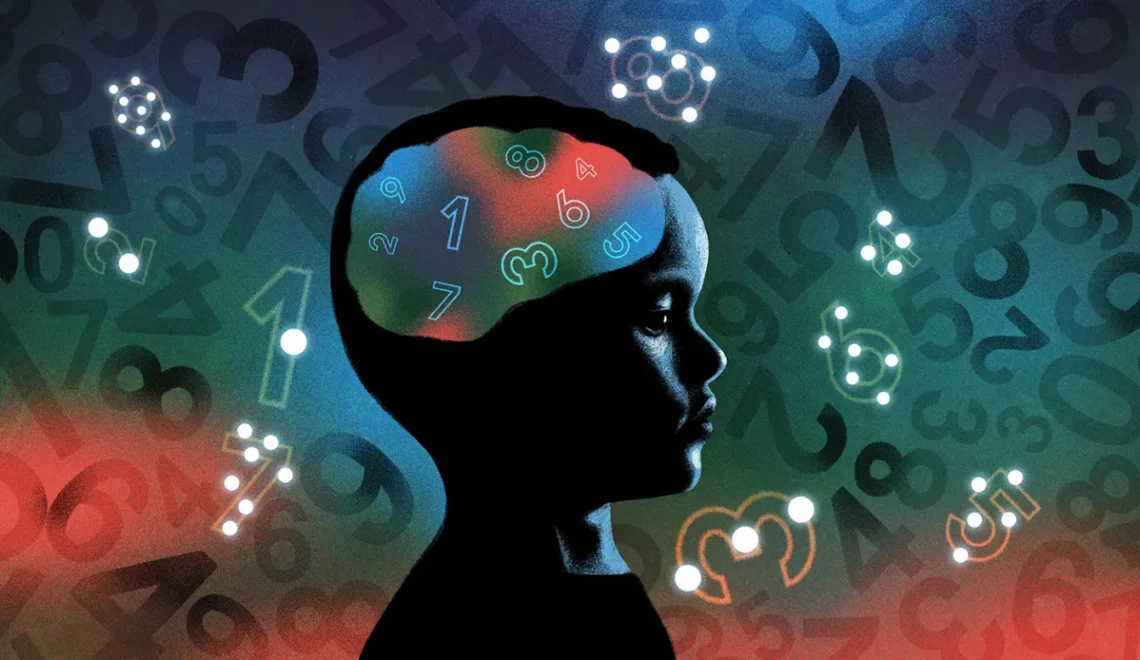
Brain Scans Reveal Why Math Is More Difficult for Some Children
New neuroscience research is offering a clearer picture of why some children struggle with math more than others. Using brain scans and behavioral testing, scientists have identified differences in both thinking patterns and brain activity that may explain why certain kids find numerical tasks especially challenging—particularly when working with number symbols.
The findings suggest that math difficulties are not caused by a single brain region or a single cognitive weakness. Instead, they emerge from subtle differences in how children process symbols, monitor their performance, and respond to mistakes.
How the Study Was Designed
Researchers worked with children in second and third grade who had previously completed standardized math assessments. Based on those results, the children were divided into two groups: those with typical math skills and those identified as having math learning difficulties.
Each child was then asked to complete simple comparison tasks on a screen, such as deciding which of two numbers (from 1 to 9) was larger. While the children solved these problems, scientists measured both their reaction times and their brain activity using MRI scans.
At the same time, researchers closely observed how the children behaved during the task—especially how carefully they responded and how they reacted after making mistakes.
The goal was not simply to measure accuracy, but to understand how children approach math problems mentally and neurologically.
Key Behavioral Differences in Math Performance
One of the first findings was a difference in decision-making style between the two groups.
Children with math learning difficulties tended to respond more quickly and with less caution when solving problems. They were also less likely to slow down after making an error.
By contrast, children with typical math skills generally adjusted their behavior after mistakes, taking more time to consider their answers.
This suggests that self-monitoring—how carefully a child evaluates their own performance—may play an important role in math ability.
The Surprising Effect of Changing Number Representation
A key discovery came when researchers changed how math problems were presented.
In a second version of the task, numbers were replaced with visual dot patterns instead of symbolic numerals. When children worked with these dot representations, the differences between the two groups largely disappeared.
Children with math learning difficulties became more cautious and showed behavior patterns similar to their peers with typical math skills. They also slowed down after making mistakes in the same way.
This shift suggests that the difficulty may not be in understanding quantity itself, but in processing symbolic numbers.
Why Symbolic Numbers Are a Challenge
Experts not involved in the study note that this finding aligns with earlier research showing that symbolic number processing is often the core difficulty in math learning disorders.
Bert De Smedt, a researcher in the neuroscience of learning at KU Leuven, explains that children with math difficulties often struggle more with numerals than with actual quantities.
In other words, recognizing that the symbol “7” represents a quantity may be more difficult than understanding seven physical objects, such as dots or shapes.
The new study adds detail to this idea by showing how behavior and brain activity change depending on whether children are working with symbols or visual quantities.
What Brain Scans Revealed
While children completed the tasks, researchers monitored activity in different brain regions associated with reasoning, attention, and error detection.
Two areas stood out in particular:
The middle frontal gyrus, which is involved in working memory and numerical thinking, showed reduced activity in children with math difficulties when they were working quickly and less cautiously with symbols.
The anterior cingulate cortex, a region responsible for detecting mistakes and monitoring performance, also showed lower activity in the math difficulty group—especially when children failed to slow down after making errors.
These patterns suggest that both numerical processing and self-monitoring systems may function differently when children struggle with symbolic math.
Why Dot-Based Problems Changed Brain Activity
Interestingly, these differences in brain activity were not present when children worked with dot patterns instead of symbols.
In that condition, both groups showed similar activation in the key brain regions, and their behavior became more alike.
This suggests that the brain processes quantity more naturally when it is presented visually, without symbolic interpretation.
It also supports the idea that part of early math difficulty may come from the extra cognitive step required to translate symbols into meaning.
What Scientists Say About the Findings
Researchers emphasize that the study does not prove that brain activity directly causes math difficulties. Instead, it highlights patterns that may contribute to them.
Hyesang Chang, a cognitive neuroscientist involved in the research, explains that the goal was to understand how children approach math tasks differently rather than simply comparing performance outcomes.
The findings suggest that even small differences in attention, caution, and error response can influence how effectively children process mathematical information.
Math Is a Distributed Brain Process
Experts also point out that math does not rely on a single brain region.
Marie Arsalidou, a neuroscientist specializing in child brain development, notes that multiple areas of the brain are involved in mathematical thinking, including regions responsible for memory, attention, and error detection.
This means that math ability is shaped by a network of cognitive systems working together, rather than one isolated “math center” in the brain.

Hidden Mechanisms Behind Math Learning
One of the most important implications of the research is that math learning difficulties may stem from subtle, hidden differences in cognitive processing.
These differences are not always obvious in test scores alone. Instead, they appear in how children regulate their attention, respond to errors, and interpret symbols.
Understanding these mechanisms could help explain why some children struggle despite having normal intelligence and exposure to math instruction.
What This Could Mean for Education
Researchers suggest that future teaching methods could focus more on helping children become aware of how they approach problem-solving.
For example, students who struggle with math might benefit from strategies that encourage them to slow down, check their answers, and reflect on mistakes before moving forward.
Instruction that gradually transitions from visual quantities (like dots) to symbolic numbers may also help bridge the gap in understanding.
Final Insight: Math Difficulties Are More Complex Than They Appear
The study highlights that math learning difficulties are not simply about getting answers wrong—they reflect deeper differences in how the brain processes symbols, manages attention, and responds to errors.
By identifying these patterns early, educators and researchers may be able to design better interventions that support children before small struggles turn into long-term learning barriers.
Ultimately, the research reinforces a key idea: mathematical ability is shaped by both cognition and brain function, and understanding that interaction is essential for improving education strategies.